
Thursday, August 31, 2006
Voters Everywhere Agree Political System "Badly Broken"
According to a recent survey conducted by the Rasmussen Reports , a plurality of voters in each of 32 states agree that the political system in the U.S. is "badly broken." Percentages range from a high of 63% in Vermont to 47% in Nebraska. An earlier Rasmussen national survey found that just 48% of American adults believe that elections are generally fair to voters. Voters in New York are more likely than in any other state to express a concern about voter suppression. Thirty-four percent (34%) of Empire State voters hold this view.


Wednesday, August 30, 2006
Learn How to Build an Earth Oven
I am going to learn how to build an earth oven this weekend at the Tickletown Sustainable Living Festival in Great Valley. I will also be exhibiting natural building and environmental books. The festival, this Saturday and Sunday, Sept. 2 and 3, has been organized by Lois Hilton, a member of the Cattaraugus Greens. "I want this to be a community creation where everyone has input in the design. We'll have fun," Lois said in an interview in the Olean Times Herald. "Everyone is going to be encouraged to take part. We'll mix the cob with our feet on a tarp." Cob is the old English word for "lump." The dome part of the outdoor radiant-heat earth oven is constructed by forming lumps of clay dirt, sand, straw and water over a base of wet sand that is later removed.
The weekend begins at 10 a.m. Saturday with a potluck meal and discussion on sustainable local living. Participants will spend all afternoon building the oven and receive a sourdough bread-making lesson before an evening potluck, camping and acoustic jam. On Sunday morning, the oven builders will pull out the inner sand formation and fire up some wood on its brick floor. Then the coals will be pulled out and the 27-inch-wide, 22-inch-high oven will remain hot enough on the inside for another three to four hours to bake breads, roasts, pizzas, cookies and the like. The downdraft system will take cool air through the bottom part of the door, circle it up through the dome and send the hot air through the top part of the door. To protect the oven from the elements, Mark of Excellence landscaping and carpentry company is designing a living roof, growing a canopy of vine leaves attached to nearby locust trees.
Location: Tickletown Trust and Trade, 4484 Humphyrey Road, Great Valley, NY 14741 (near Olean). All ages welcome! For information, call 716-945-5460 or email tickletown@gmail.com
The weekend begins at 10 a.m. Saturday with a potluck meal and discussion on sustainable local living. Participants will spend all afternoon building the oven and receive a sourdough bread-making lesson before an evening potluck, camping and acoustic jam. On Sunday morning, the oven builders will pull out the inner sand formation and fire up some wood on its brick floor. Then the coals will be pulled out and the 27-inch-wide, 22-inch-high oven will remain hot enough on the inside for another three to four hours to bake breads, roasts, pizzas, cookies and the like. The downdraft system will take cool air through the bottom part of the door, circle it up through the dome and send the hot air through the top part of the door. To protect the oven from the elements, Mark of Excellence landscaping and carpentry company is designing a living roof, growing a canopy of vine leaves attached to nearby locust trees.
Location: Tickletown Trust and Trade, 4484 Humphyrey Road, Great Valley, NY 14741 (near Olean). All ages welcome! For information, call 716-945-5460 or email tickletown@gmail.com
Monday, August 28, 2006
Organic Consumers Fund Candidate Survey
I have completed the Organic Consumers Fund's candidate survey. Read my responses here. I enthusiastically endorse the health benefits of eating locally-grown, organic food and of growing food organically.
I grew up on a small organic family farm eating homegrown vegetables, fruits, meat and dairy, and I returned several years ago to live on my parents' small organically-run farm in Hammondsport. I am a member of the Northeast Organic Farming Association of New York. In 2005, I helped organize Southern Tier Farm to You, and helped the group produce a directory of locally-grown food producers in Allegany, Chemung, Schuyler and Steuben counties.
I wish the survey had addressed what we can do about the fact that large industrial agricultural corporations with interlocking ownership have acquired control of the production of food labelled 'organic'. Many of the small farmers I know can't afford to pay the annual fees for organic certification.
I favor empowering local communities to make laws regarding food production within their communities. As attorney general, I will not support an interpretation of New York's right to farm law that permits it to override the right to municipal home rule granted by the New York constitution. The right to farm law as currently interpreted by the NY Agriculture and Markets Department prevents communities from regulating large industrial agricultural operations in their midst, such as confined animal feedlots that violate animal welfare laws and release toxics into the air and water, or farms using genetically modified organisms. This interpretation is incorrect and invalidly nullifies the right to municipal home rule.
I grew up on a small organic family farm eating homegrown vegetables, fruits, meat and dairy, and I returned several years ago to live on my parents' small organically-run farm in Hammondsport. I am a member of the Northeast Organic Farming Association of New York. In 2005, I helped organize Southern Tier Farm to You, and helped the group produce a directory of locally-grown food producers in Allegany, Chemung, Schuyler and Steuben counties.
I wish the survey had addressed what we can do about the fact that large industrial agricultural corporations with interlocking ownership have acquired control of the production of food labelled 'organic'. Many of the small farmers I know can't afford to pay the annual fees for organic certification.
I favor empowering local communities to make laws regarding food production within their communities. As attorney general, I will not support an interpretation of New York's right to farm law that permits it to override the right to municipal home rule granted by the New York constitution. The right to farm law as currently interpreted by the NY Agriculture and Markets Department prevents communities from regulating large industrial agricultural operations in their midst, such as confined animal feedlots that violate animal welfare laws and release toxics into the air and water, or farms using genetically modified organisms. This interpretation is incorrect and invalidly nullifies the right to municipal home rule.
Tuesday, August 22, 2006
Petition Filed Today
I am just returned from Albany where the state candidates filed our independent nominating petition with the state board of elections at 11:00 am today. The exact number of signatures was not counted, but it is about 30,000, double the 15,000 required. 7,195 pages of signatures were filed.
A team of Greens from around the state worked in Albany all weekend to get the petitions ready for filing. Judy Einach (the state petition coordinator from Buffalo), Ian Wilder (state co-chair from Babylon), Eric Jones (a state executive committee member from Buffalo) and Jerry Kann (a state committee member from Queens and a member of Howie Hawkins campaign staff) worked all night, finishing the two sets of copies at Kinko's at 7:00 am this morning.
Many thanks to everyone who collected and cleaned signatures! The top petitioners statewide were Jerry Kann and Howie Hawkins with about 3,000 signatures each.
Several reporters, including Associated Press, came to our press conference at the BOE, and then we went to the press room in the capitol building to visit with other reporters. All the reporters are interested to know if we will be in the debates. Now that we have submitted our petitions and presumably will be on the ballot, we are pressing to be included in the debates. General objections to our petitions have to be filed by Friday.
A team of Greens from around the state worked in Albany all weekend to get the petitions ready for filing. Judy Einach (the state petition coordinator from Buffalo), Ian Wilder (state co-chair from Babylon), Eric Jones (a state executive committee member from Buffalo) and Jerry Kann (a state committee member from Queens and a member of Howie Hawkins campaign staff) worked all night, finishing the two sets of copies at Kinko's at 7:00 am this morning.
Many thanks to everyone who collected and cleaned signatures! The top petitioners statewide were Jerry Kann and Howie Hawkins with about 3,000 signatures each.
Several reporters, including Associated Press, came to our press conference at the BOE, and then we went to the press room in the capitol building to visit with other reporters. All the reporters are interested to know if we will be in the debates. Now that we have submitted our petitions and presumably will be on the ballot, we are pressing to be included in the debates. General objections to our petitions have to be filed by Friday.
Sunday, July 30, 2006
Compassionate Consumers Picnic, July 30
Today I attended a picnic and fundraiser in Rochester for Adam Durand of Compassionate Consumers. The event was co-sponsored by Green Party of Monroe County. The fundraiser was to help with Adam's appeal of his conviction for trespassing. In 2004 Adam and two others entered New York State's largest egg farm to document animal cruelty. Since that time his organization, Compassionate Consumers, has worked to educate the public about this cruelty and convince the Wegmans corporation, the farm's owner, to improve the conditions there. I circulated my position paper on the illegality of battery cages under the New York Agriculture and Markets Law.
Tuesday, July 18, 2006
Process for Brooklyn Development an Insult to Democracy
Speech at the Develop Don't Destroy Brooklyn rally at Grand Army Plaza in Brooklyn, July 16, 2006
The number of people here on this hot Sunday afternoon, demonstrates the frustration people feel at the lack of opportunity for democratic participation in the project planning process for the development at the Atlantic Yards by the Forest City Ratner Corporation.
It is more than a LACK of democracy. The subversion of state and city law by the two authorities overseeing this development is an INSULT to democracy.
The city's land use laws, the state's eminent domain laws, the state's budgeting process, the city's budgeting process, and the state's new reform laws for public benefit corporations are all are being subverted to serve the interests of the largest publicly traded real estate development corporation in the United States. Forest City Enterprises, Inc., an $8 billion company and the parent corporation of the Forest City Ratner Corporation.
But the biggest insult to democracy is that all this is proceeding with the most minimal participation by the city's elected representatives.
The very first sentence of the New York Constitution says 'no member of this state shall be disenfranchised.' The people of Brooklyn have been disenfranchised by the process we witness here.
Furthermore, Article 9 of the New York constitution relating to municipal home rule states that, 'effective local self-government [is a purpose] of the people of the state.' There is no way that the process by which this development is proceeding constitutes effective local self-government.
Two unelected bodies, the Empire State Development Authority and the Metropolitan Transportation Authority, whose members have been appointed by the governor of New York are rubber-stamping whatever the Forest City Ratner Corporation asks for. No one is representing the interests of the public.
As attorney general, I will enforce the laws that are being subverted here.
The number of people here on this hot Sunday afternoon, demonstrates the frustration people feel at the lack of opportunity for democratic participation in the project planning process for the development at the Atlantic Yards by the Forest City Ratner Corporation.
It is more than a LACK of democracy. The subversion of state and city law by the two authorities overseeing this development is an INSULT to democracy.
The city's land use laws, the state's eminent domain laws, the state's budgeting process, the city's budgeting process, and the state's new reform laws for public benefit corporations are all are being subverted to serve the interests of the largest publicly traded real estate development corporation in the United States. Forest City Enterprises, Inc., an $8 billion company and the parent corporation of the Forest City Ratner Corporation.
But the biggest insult to democracy is that all this is proceeding with the most minimal participation by the city's elected representatives.
The very first sentence of the New York Constitution says 'no member of this state shall be disenfranchised.' The people of Brooklyn have been disenfranchised by the process we witness here.
Furthermore, Article 9 of the New York constitution relating to municipal home rule states that, 'effective local self-government [is a purpose] of the people of the state.' There is no way that the process by which this development is proceeding constitutes effective local self-government.
Two unelected bodies, the Empire State Development Authority and the Metropolitan Transportation Authority, whose members have been appointed by the governor of New York are rubber-stamping whatever the Forest City Ratner Corporation asks for. No one is representing the interests of the public.
As attorney general, I will enforce the laws that are being subverted here.
Monday, June 26, 2006
Exxon's Oil Spill in Brooklyn
Press conference in Greenpoint, Brooklyn, June 24, 2006. Video of Press Conference Hi Res, Dial-Up, Third Planet Video, June 24, 2006, 10 min.
I have called this press conference to commend the DEC's announcement, reported on Thursday, that it has requested the attorney general to take legal action against Exxon for its failure to clean up millions of gallons of petroleum pollution in the Brooklyn aquifer and surrounding soils. I have been working as a Sierra Club activist since 1996 trying to get the spill cleaned up. I look forward to prosecuting the case when I am elected.
This oil spill is a huge and long-standing crime. It is the largest urban oil spill in the United States, two to four times as large as the Exxon Valdez spill in Alaska. It was obvious to the company in 1954 when a large gas explosion occurred in the Socony-Vacuum petroleum storage facilities that millions of gallons of its petroleum products had sunk onto the Brooklyn acquifer, but the company did not clean up or disclose the spill. Even after the spill was discovered leaking into Newtown Creek in 1978 by the US Coast Guard, the company denied liability for years.
It is important to make Exxon live up to its obligations under New York and federal law to clean up the spill and pay for damages. We need to show that large corporate criminals are not above the law.
Had the spill been cleaned up as soon as it occurred, much of the damage caused by the petroleum over the last 52 years would have been avoided. Two generations of people in Brooklyn would not have lived with the damaging effects of petroleum vapors seeping through their soil, into their houses and into their bodies.
The aquifer might have been restored and available to the city as a source of water. Until 1947 the Brooklyn municipal water system depended on ground water. Pumping had stopped at the time of the spill because the depression in the water table caused by extensive pumping was causing sea water to flow into the aquifer, but as the aquifer replenished itself, pumping could have resumed if the petroleum contamination from the spill had been cleaned up.
As long as the oil remains on the aquifer next to Newtown Creek, there is the possibility of tremendous damage from large flows of oil into the creek and New York harbor. At any time natural or human forces may cause the oil to breach the barriers that have so far confined it underground.
I took my first tour of this area ten years ago with Concerned Citizens of Greenpoint and the Greenpoint Watchperson's office. Our Sierra Club Eco Restoration Committee studied the spill extensively. One of the things we looked at was the Geraghty and Miller report on the spill prepared for the US Coast Guard in 1979.
I would like to show you one of the pages of that report. This map shows the contours on the water table in Brooklyn in 1936 and it shows something very interesting. See this cone of depression in the water table of 35 feet below sea level in the Fort Greene area?
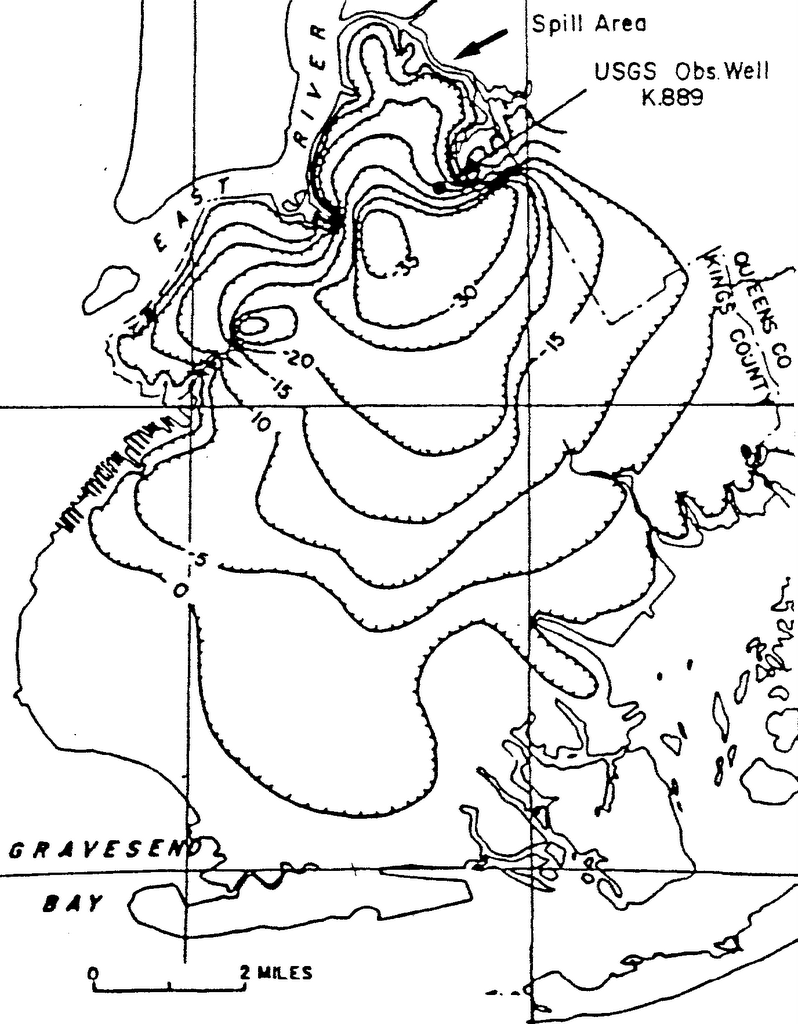
Contours on water table in Brooklyn in 1936. Figure 4 of the Geraghty and Miller Report, Investigation of Underground Accumulation of Hydrocarbons along Newtown Creek, Brooklyn, New York, prepared for the U.S. Coast Guard, July 1979. Altitudes are in feet below mean sea level.
Compare this now to this graphic from the DEC's January 2005 community presentation on the spill showing how the hydrocarbon product floating on top of the water table flows into a cone of depression created by ground water pumping.
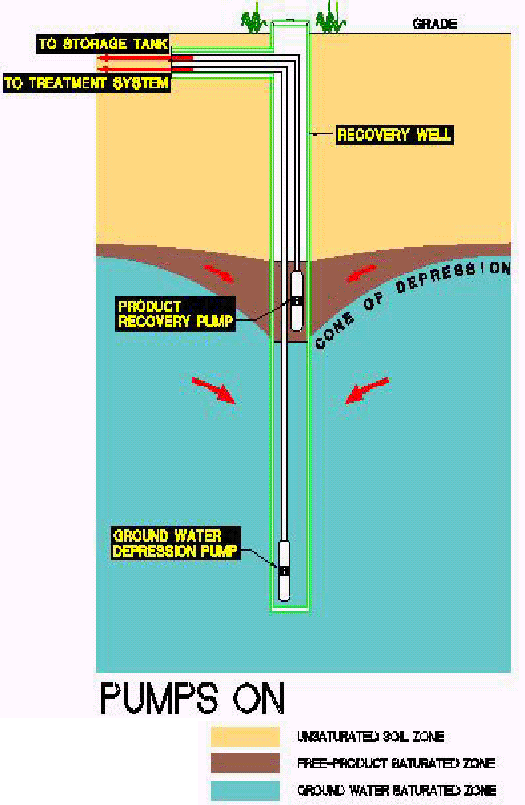
The Cone of Depression. Illustration by the DEC showing how the petroleum recovery system is using the cone of depression created by pumping the groundwater to recover the petroleum product. From http://www.dec.state.ny.us/ website/der/projects/reg2/greenpoint/s224087e.pdf
You can see there is a strong possibility that the petroleum products from the Socony-Vacuum spill traveled south into the cone of depression caused by the pumping, and that as ground water levels rose in the years following the spill because the groundwater pumping was never restarted, petroleum contamination may have spread broadly over large areas of the Brooklyn aquifer. There is good reason to think that the damage is more extensive than is generally assumed.For more information about the spill, visit: http://www.greenpointvexxon.com/
and http://www.dec.state.ny.us/website/der/ projects/reg2/greenpoint/. See State Plans to Sue Exxon Over Underground Oil Spill in Brooklyn, NY Times, June 22, 2006.
Thursday, June 22, 2006
That Was Quick!!
Just one day after Rachel issued a media advisory on June 21, 2006, stating that she would hold a press conference in Greenpoint, Brooklyn on June 24, 2006, to announce her plan, if elected, to sue ExxonMobil for natural resource damage to the aquifer under Brooklyn from a hydrocarbon spill occurring in 1950 and continuing to the present day, the New York Times reports on June 22, 2006, that State Plans to Sue Exxon Over Underground Oil Spill in Brooklyn. According to the article, "The Department of Environmental Conservation said yesterday that it has joined the fray, and asked New York Attorney General Eliot Spitzer to initiate legal action against Exxon 'to ensure that the company fulfills its obligation to clean up petroleum contamination' in Greenpoint."
Friday, June 16, 2006
CNN Survey 84% Against Electronic Voting
http://www.cnn.com/CNN/Programs/lou.dobbs.tonight/
I just voted and the votes are now:
Do you believe the United States should abandon electronic voting?
Yes, 84%, 9876 votes
No,16%,1913 votes
Total: 11789 votes
Original Message:
Subject: Vote Now CNN Survey on EVoting
Date: Thu, 15 Jun 2006 23:32:34 -0400
From: "Bo Lipari"
Organization: New Yorkers for Verified Voting
Go vote online now. Top item on the left.
http://www.cnn.com/CNN/Programs/lou.dobbs.tonight/
Do you believe the United States should abandon electronic voting?
Yes, 84%, 952 votes
No, 16%,183 votes
Total: 1135 votes
I just voted and the votes are now:
Do you believe the United States should abandon electronic voting?
Yes, 84%, 9876 votes
No,16%,1913 votes
Total: 11789 votes
Original Message:
Subject: Vote Now CNN Survey on EVoting
Date: Thu, 15 Jun 2006 23:32:34 -0400
From: "Bo Lipari"
Organization: New Yorkers for Verified Voting
Go vote online now. Top item on the left.
http://www.cnn.com/CNN/Programs/lou.dobbs.tonight/
Do you believe the United States should abandon electronic voting?
Yes, 84%, 952 votes
No, 16%,183 votes
Total: 1135 votes
Thursday, June 15, 2006
Comments on proposed Cohocton Local Wind Law
To the Cohocton Town Board and Cohocton Town Planning Board, Cohocton, New York
Comments filed June 14, 2006
As a resident of Steuben County and a candidate for Attorney General, I have studied the proposals for industrial wind farms being made to towns in our county. Like almost everyone, I am strongly in favor of clean energy. We need to reduce our energy consumption and generate the energy we do use from non-toxic sources, such as wind. But we cannot be blinded by our desire for clean energy into failing to properly evaluate the wind farm schemes being proposed for our county.
First of all we need to know how much effective electric capacity the proposed wind farms will actually produce. The haste with which large industrial wind farms are being pushed for construction in all the top wind resource areas of our county precludes adequate consideration of this issue. We need to slow down and begin with construction of just a few turbines so residents and officials can find out how much electric energy can actually be generated in this area and get actual experience in the amount of noise, flicker, ice throw, harm to wildlife and harm to property values that will be generated by turbines of the huge size being proposed.
The large federal and state subsidies and tax benefits being granted to wind energy production do not guarantee that it is economic to produce electricity from wind in this area, and if it is not, the projects will fail. Nor will these subsidies and tax benefits prevent property values in our area from declining due to the presence of industrial wind farms.
For these reasons, I recommend that the town of Cohocton take time to adequately study the effects of having industrial wind farms in Cohocton, and that the proposed Cohocton wind law be amended to:
1. Limit the number of industrial size turbines that can be constructed in 2006 and 2007 to one
2. Require the public recording of wind energy leases in order to be enforceable
3. Establish adequate setbacks to take into account the rights of adjacent landowners to the wind energy flowing across their properties.
4. Require the owners of large wind turbines to make quarterly public disclosures of the electric energy produced by each turbine
5. Require the owners of large wind turbines to post bonds for road repair
6. Set up procedures by which property value decline can be measured and require the owners of large wind turbines to post bonds for harm to property values.
Adding these requirements will give the residents of Cohocton the time and information necessary to more adequately evaluate the proposed project.
The proposed Cohocton local law is posted on the Cohocton Wind Watch website at http://batr.net/cohoctonwindwatch/WindmillLaw5-8-06.pdf
Comments filed June 14, 2006
As a resident of Steuben County and a candidate for Attorney General, I have studied the proposals for industrial wind farms being made to towns in our county. Like almost everyone, I am strongly in favor of clean energy. We need to reduce our energy consumption and generate the energy we do use from non-toxic sources, such as wind. But we cannot be blinded by our desire for clean energy into failing to properly evaluate the wind farm schemes being proposed for our county.
First of all we need to know how much effective electric capacity the proposed wind farms will actually produce. The haste with which large industrial wind farms are being pushed for construction in all the top wind resource areas of our county precludes adequate consideration of this issue. We need to slow down and begin with construction of just a few turbines so residents and officials can find out how much electric energy can actually be generated in this area and get actual experience in the amount of noise, flicker, ice throw, harm to wildlife and harm to property values that will be generated by turbines of the huge size being proposed.
The large federal and state subsidies and tax benefits being granted to wind energy production do not guarantee that it is economic to produce electricity from wind in this area, and if it is not, the projects will fail. Nor will these subsidies and tax benefits prevent property values in our area from declining due to the presence of industrial wind farms.
For these reasons, I recommend that the town of Cohocton take time to adequately study the effects of having industrial wind farms in Cohocton, and that the proposed Cohocton wind law be amended to:
1. Limit the number of industrial size turbines that can be constructed in 2006 and 2007 to one
2. Require the public recording of wind energy leases in order to be enforceable
3. Establish adequate setbacks to take into account the rights of adjacent landowners to the wind energy flowing across their properties.
4. Require the owners of large wind turbines to make quarterly public disclosures of the electric energy produced by each turbine
5. Require the owners of large wind turbines to post bonds for road repair
6. Set up procedures by which property value decline can be measured and require the owners of large wind turbines to post bonds for harm to property values.
Adding these requirements will give the residents of Cohocton the time and information necessary to more adequately evaluate the proposed project.
The proposed Cohocton local law is posted on the Cohocton Wind Watch website at http://batr.net/cohoctonwindwatch/WindmillLaw5-8-06.pdf
Sunday, June 11, 2006
Local Groups Oppose Corporate Water Mining
Articles about this event appeared in the Ithaca Times, the Corning Leader, the Elmira Star-Gazette, the Watkins Express and the Dundee Observer and on Laura Hand's show on WSTM in Syracuse. Participants decided to form a regional water protection network.
Community Water Rights Protection Workshop
Date: June 9-10, 2006
Location: Rural-Urban Center, 208 Broadway, Montour Falls
Alarmed that water resources in the Finger Lakes will be targeted by large corporate water companies for privatization of municipal water services and for mining bottled water, the Finger Lakes Progressive Coalition and the Finger Lakes Group of the Sierra Club sponsored a Water Rights Protection Workshop June 9 and 10, 2006, at the Rural-Urban Center in Montour Falls. The workshop was for members of the public to learn how to prevent corporate control of water resources and services in our Finger Lakes and Southern Tier communities.
"Here in the Finger Lakes we take for granted ample supplies of fresh water, but as fresh water becomes an increasingly valuable commodity, large corporations are setting their sights on the giant reservoirs of fresh water in our lakes and aquifers for distribution and profit," said Rachel Treichler of Hammondsport, a member of the Sierra Club, and one of the organizers of the program.
"Members of the Finger Lakes Progressives are watching water privatization efforts in surrounding states; including Pennsylvania and N. H., with alarm," Jack Ossont of Yates county, coordinator of the Progressive Coalition, remarked. "Folks in the Finger Lakes have always regarded water as a resource for the use of all and we organized this workshop to help us keep it that way."
The workshop was led by two nationally known experts on community water issues: Victoria Kaplan, national organizer of the Water for All Campaign with Food and Water Watch in Washington, DC, and Ruth Caplan, national coordinator of the Alliance for Democracy's Defending Water for Life campaign and chair of Sierra Club's national Water Privatization Task Force.
Their presentations showed what communities can do when municipal water and sewer services are targeted for corporate takeover and when local water resources are targeted by bottling companies. The workshop featured discussion of who has the rights to make decisions about water usage in a community.
"From Mt. Shasta, California to Bigelow Mountain in Maine, Nestle and other giant corporations are pursuing big profits pumping pristine water from America's gems of nature to put in little plastic bottles", warns Ruth Caplan. "Now is the time to act, if you don't want this to happen to the Finger Lakes."
"Communities around the country and around the world have experienced major problems when a corporation gets control of their water--from rate increases to declining customer service," said Victoria Kaplan. "Luckily, residents of the Finger Lakes region have a great opportunity right now to protect their water for future generations."
Friday evening's program featured a showing of the prize-winning 62-minute documentary Thirst and a discussion of the issues it raises: Is water part of a shared commons, a human right for all people? Or is it a commodity to be bought, sold, and traded in a global marketplace?
In Saturday's program, Victoria Kaplan addressed municipal privatization issues and Ruth Caplan talked about how water bottling companies are taking local water supplies and what communities are doing about it.
The workshop schedule is at: http://www.ecobooks.com/fingerlakeswaterworkshop.html.
Learn more about Food and Water Watch at http://www.foodandwaterwatch.org/water/waterprivatization
Learn more about the Alliance for Democracy Defending Water for Life Campaign at http://www.thealliancefordemocracy.org/water
Learn more about the Sierra Club Water Privatization Task Force at http://www.sierraclub.org/cac/water/
Learn more about the Finger Lakes Group of the Sierra Club at http://newyork.sierraclub.org/fingerlakes/
Learn more about New York Democracy Schools at http://www.ecobooks.com/FLdemocracyschool.htm
Community Water Rights Protection Workshop
Date: June 9-10, 2006
Location: Rural-Urban Center, 208 Broadway, Montour Falls
Alarmed that water resources in the Finger Lakes will be targeted by large corporate water companies for privatization of municipal water services and for mining bottled water, the Finger Lakes Progressive Coalition and the Finger Lakes Group of the Sierra Club sponsored a Water Rights Protection Workshop June 9 and 10, 2006, at the Rural-Urban Center in Montour Falls. The workshop was for members of the public to learn how to prevent corporate control of water resources and services in our Finger Lakes and Southern Tier communities.
"Here in the Finger Lakes we take for granted ample supplies of fresh water, but as fresh water becomes an increasingly valuable commodity, large corporations are setting their sights on the giant reservoirs of fresh water in our lakes and aquifers for distribution and profit," said Rachel Treichler of Hammondsport, a member of the Sierra Club, and one of the organizers of the program.
"Members of the Finger Lakes Progressives are watching water privatization efforts in surrounding states; including Pennsylvania and N. H., with alarm," Jack Ossont of Yates county, coordinator of the Progressive Coalition, remarked. "Folks in the Finger Lakes have always regarded water as a resource for the use of all and we organized this workshop to help us keep it that way."
The workshop was led by two nationally known experts on community water issues: Victoria Kaplan, national organizer of the Water for All Campaign with Food and Water Watch in Washington, DC, and Ruth Caplan, national coordinator of the Alliance for Democracy's Defending Water for Life campaign and chair of Sierra Club's national Water Privatization Task Force.
Their presentations showed what communities can do when municipal water and sewer services are targeted for corporate takeover and when local water resources are targeted by bottling companies. The workshop featured discussion of who has the rights to make decisions about water usage in a community.
"From Mt. Shasta, California to Bigelow Mountain in Maine, Nestle and other giant corporations are pursuing big profits pumping pristine water from America's gems of nature to put in little plastic bottles", warns Ruth Caplan. "Now is the time to act, if you don't want this to happen to the Finger Lakes."
"Communities around the country and around the world have experienced major problems when a corporation gets control of their water--from rate increases to declining customer service," said Victoria Kaplan. "Luckily, residents of the Finger Lakes region have a great opportunity right now to protect their water for future generations."
Friday evening's program featured a showing of the prize-winning 62-minute documentary Thirst and a discussion of the issues it raises: Is water part of a shared commons, a human right for all people? Or is it a commodity to be bought, sold, and traded in a global marketplace?
In Saturday's program, Victoria Kaplan addressed municipal privatization issues and Ruth Caplan talked about how water bottling companies are taking local water supplies and what communities are doing about it.
The workshop schedule is at: http://www.ecobooks.com/fingerlakeswaterworkshop.html.
Learn more about Food and Water Watch at http://www.foodandwaterwatch.org/water/waterprivatization
Learn more about the Alliance for Democracy Defending Water for Life Campaign at http://www.thealliancefordemocracy.org/water
Learn more about the Sierra Club Water Privatization Task Force at http://www.sierraclub.org/cac/water/
Learn more about the Finger Lakes Group of the Sierra Club at http://newyork.sierraclub.org/fingerlakes/
Learn more about New York Democracy Schools at http://www.ecobooks.com/FLdemocracyschool.htm
Friday, May 26, 2006
Cohocton Wind Hearing
Last evening I attended the hearing on the draft environmental impact statement for the Cohocton Wind project at the Cohocton Elementary School. Many speakers called for the town to have a referendum on the project.
The Cohocton DEIS, like the Prattsburgh EIS, (both projects are under the control of the same company and several speakers asked why segmentation of the EIS was allowed) fails to address the economic benefits of the project except in the most cursory way.
The New York State Environmental Quality Review Act requires weighing the economic benefit of a project against its environmental impact. The Cohocton DEIS describes the economic benefit as follows:
" The purpose of the proposed action is to create a wind-powered electrical-generating facility that will provide a significant source of renewable energy to the New York State power grid. . . . These objectives include stimulating economic growth, increasing energy diversity, and promoting a cleaner and healthier environment. The benefits of the proposed action include positive impacts on socioeconomics (e.g., increased payment-in-lieu of tax [PILOT] revenues to local municipalities and lease revenues to participating landowners), air quality (through reduction of emissions from fossil-fuel-burning power plants), and climate (reduction of greenhouse gases that contribute to global warming)."
That is it. Three conclusory sentences out of hundreds of pages in the DEIS and appendices.
The Cohocton DEIS, like the Prattsburgh EIS, (both projects are under the control of the same company and several speakers asked why segmentation of the EIS was allowed) fails to address the economic benefits of the project except in the most cursory way.
The New York State Environmental Quality Review Act requires weighing the economic benefit of a project against its environmental impact. The Cohocton DEIS describes the economic benefit as follows:
" The purpose of the proposed action is to create a wind-powered electrical-generating facility that will provide a significant source of renewable energy to the New York State power grid. . . . These objectives include stimulating economic growth, increasing energy diversity, and promoting a cleaner and healthier environment. The benefits of the proposed action include positive impacts on socioeconomics (e.g., increased payment-in-lieu of tax [PILOT] revenues to local municipalities and lease revenues to participating landowners), air quality (through reduction of emissions from fossil-fuel-burning power plants), and climate (reduction of greenhouse gases that contribute to global warming)."
That is it. Three conclusory sentences out of hundreds of pages in the DEIS and appendices.
Monday, May 22, 2006
Iraq War Against Voter Wishes
We are at war in Iraq against the wishes of most voters. This is possible because illegal barriers to voting and ballot access have allowed money to trump democracy in our electoral system.
As Attorney General, I will protect our rights to vote and our rights to free and fair elections. We can't continue to let the short-term economic interests of a few override the long-term life, liberty and happiness of all.
The democratic principles upon which this country was founded require that each person have an equal voice in decision making.
As Attorney General, I will protect our rights to vote and our rights to free and fair elections. We can't continue to let the short-term economic interests of a few override the long-term life, liberty and happiness of all.
The democratic principles upon which this country was founded require that each person have an equal voice in decision making.
Nominated by Green Party of New York
I have been selected as the nominee for Attorney General by the Green Party of New York at its convention in Albany on May 20, 2006.
I am honored to be a member of the Green Party's Peace Slate consisting of author Malachy McCourt for governor, Green Party co-founder Howie Hawkins for US Senate, labor activist Alison Duncan for Lt. Governor, and former NYC mayoral candidate Julia Willebrand for Comptroller.
I am honored to be a member of the Green Party's Peace Slate consisting of author Malachy McCourt for governor, Green Party co-founder Howie Hawkins for US Senate, labor activist Alison Duncan for Lt. Governor, and former NYC mayoral candidate Julia Willebrand for Comptroller.
Wednesday, May 03, 2006
Western New York Green Party Convention
This Saturday afternoon I will be in Rochester with other state Green Party candidates attending the Western New York Green Party Convention. We are expecting a good turnout of Greens from across the region. We hope you will join us!
Seven candidates are confirmed to attend the convention, and others are sending video statements. The candidates who will be attending are Lt. Governor candidate Kimberly Wilder, US Senate candidates Steve Greenfield, Howie Hawkins and Sander Hicks, and Attorney General candidates Carl Person and Rachel Treichler. Malachy McCourt, a candidate for governor, Steve Krulick, a candidate for US Senate and Alison Duncan, a candidate for Lt. Governor are sending video statements and other candidates may also.
The statewide nominees of the Green Party of New York will be chosen at the state convention May 20 in Albany. It is great that so many statewide candidates are coming to western New York to meet with Greens in our area before the convention. Many thanks to the Monroe County Green Party for hosting the convention and to our Region 6 national representative, Jason Nabewaniec, for organizing it.
Western New York Green Party Convention
Saturday May 6th, 2006
2:00 to 4:00 pm
Rochester Institute of Technology
Building 1 Room 2000, Rochester
Free and open to the public
Light refreshments will be served
All are invited to go out to dinner with the candidates after the convention.
For information about the candidates, visit the websites listed below:
Malachy McCourt, www.malachyforgovernor.com
Jeff Peress, no website
Alison Duncan, no website
Kimberly Wilder, www.votewilder.org
Steve Greenfield, www.greenfieldforsenate.org
Howie Hawkins, www.syracusegreens.org/hawkins.html
Sander Hicks, www.hicksforsenate.com
Steve Krulick, http://kryo.com/Krulick/index.htm
Carl Person, www.carlperson4NYAG.com
Rachel Treichler, www.voterachel.org
Anne Eagan, no website
Gloria Mattera, www.electgloria.org
Julia Willebrand, no website
Betty Wood, no website
Green Party of New York, www.gpnys.org
Seven candidates are confirmed to attend the convention, and others are sending video statements. The candidates who will be attending are Lt. Governor candidate Kimberly Wilder, US Senate candidates Steve Greenfield, Howie Hawkins and Sander Hicks, and Attorney General candidates Carl Person and Rachel Treichler. Malachy McCourt, a candidate for governor, Steve Krulick, a candidate for US Senate and Alison Duncan, a candidate for Lt. Governor are sending video statements and other candidates may also.
The statewide nominees of the Green Party of New York will be chosen at the state convention May 20 in Albany. It is great that so many statewide candidates are coming to western New York to meet with Greens in our area before the convention. Many thanks to the Monroe County Green Party for hosting the convention and to our Region 6 national representative, Jason Nabewaniec, for organizing it.
Western New York Green Party Convention
Saturday May 6th, 2006
2:00 to 4:00 pm
Rochester Institute of Technology
Building 1 Room 2000, Rochester
Free and open to the public
Light refreshments will be served
All are invited to go out to dinner with the candidates after the convention.
For information about the candidates, visit the websites listed below:
Malachy McCourt, www.malachyforgovernor.com
Jeff Peress, no website
Alison Duncan, no website
Kimberly Wilder, www.votewilder.org
Steve Greenfield, www.greenfieldforsenate.org
Howie Hawkins, www.syracusegreens.org/hawkins.html
Sander Hicks, www.hicksforsenate.com
Steve Krulick, http://kryo.com/Krulick/index.htm
Carl Person, www.carlperson4NYAG.com
Rachel Treichler, www.voterachel.org
Anne Eagan, no website
Gloria Mattera, www.electgloria.org
Julia Willebrand, no website
Betty Wood, no website
Green Party of New York, www.gpnys.org
Monday, May 01, 2006
Remarks about Immigrant Voting Rights
I spoke briefly about the need for immigrant voting rights in local, state and national elections at the immigrants rights rally in Ithaca today. If we are truly to protect immigrant rights, immigrants must be given the right to vote. Almost 400 people gathered in the Ithaca Commons for the rally. Excellent information about immigrant voting rights is at http://www.immigrantvoting.org, the website of the Immigrant Voting Project.
Sunday, April 30, 2006
Justice Requires Immigrant Voting Rights
Ron Hayduk, the author of "Democracy for All: Restoring Immigrant Voting Rights in the United States" (2006), and co-director of the Immigrant Voting Project explains the reasons for allowing immigrant voting on Alternet. Here are a few excerpts:
"Although it's not widely known, noncitizen voting is as old as the Republic itself and as American as apple pie and baseball. Noncitizens voted from 1776 until 1926 in forty states and federal territories in local, state and even federal elections. Noncitizens also held public office. In a country where "no taxation without representation" was a rallying cry for revolution, such a proposition was not far-fetched. It was common sense that government should rest on the consent of the governed. The idea that noncitizens should have the vote is older, was practiced longer, and is more consistent with democratic ideals than the idea that they should not."
"Discriminatory public policy and private practices -- in employment, housing, education, healthcare, welfare and criminal justice -- are the inevitable by-products of immigrant political exclusion, not to mention racial profiling, xenophobic hate crimes and arbitrary detention and deportation. Non-citizens suffer social and economic inequities, in part because policy-makers can ignore their interests. Denying immigrants local voting rights makes government officials less accountable and undermines the legitimacy of public policies. Immigrant voting rights would help reverse inequities and make the American political system more democratic. Most immigrants want to become U.S. citizens, but the naturalization process can take eight to ten years. That's more than the cycle for two-term mayors, governors and state and local representatives. Moreover, not all immigrants are eligible to become U.S. citizens, unlike earlier times when nearly every immigrant could naturalize.
"Advocates of noncitizen voting support opening up the naturalization process and creating new pathways to citizenship. Noncitizen voting would facilitate civic education and participation and better prepare incipient Americans for eventual citizenship. This burgeoning movement to create a truly universal suffrage calls forth America's past and future as an immigrant nation.
"The right to vote ensures that American democracy is inclusive and fair. Extending the right to vote to noncitizens would help keep government representative, responsive and accountable to all. It would not only restore a tried and true American practice but would also update our democracy for these global times. The immigrant rights movement is today's civil rights movement and noncitizen voting is the suffrage movement of our time."
"Although it's not widely known, noncitizen voting is as old as the Republic itself and as American as apple pie and baseball. Noncitizens voted from 1776 until 1926 in forty states and federal territories in local, state and even federal elections. Noncitizens also held public office. In a country where "no taxation without representation" was a rallying cry for revolution, such a proposition was not far-fetched. It was common sense that government should rest on the consent of the governed. The idea that noncitizens should have the vote is older, was practiced longer, and is more consistent with democratic ideals than the idea that they should not."
"Discriminatory public policy and private practices -- in employment, housing, education, healthcare, welfare and criminal justice -- are the inevitable by-products of immigrant political exclusion, not to mention racial profiling, xenophobic hate crimes and arbitrary detention and deportation. Non-citizens suffer social and economic inequities, in part because policy-makers can ignore their interests. Denying immigrants local voting rights makes government officials less accountable and undermines the legitimacy of public policies. Immigrant voting rights would help reverse inequities and make the American political system more democratic. Most immigrants want to become U.S. citizens, but the naturalization process can take eight to ten years. That's more than the cycle for two-term mayors, governors and state and local representatives. Moreover, not all immigrants are eligible to become U.S. citizens, unlike earlier times when nearly every immigrant could naturalize.
"Advocates of noncitizen voting support opening up the naturalization process and creating new pathways to citizenship. Noncitizen voting would facilitate civic education and participation and better prepare incipient Americans for eventual citizenship. This burgeoning movement to create a truly universal suffrage calls forth America's past and future as an immigrant nation.
"The right to vote ensures that American democracy is inclusive and fair. Extending the right to vote to noncitizens would help keep government representative, responsive and accountable to all. It would not only restore a tried and true American practice but would also update our democracy for these global times. The immigrant rights movement is today's civil rights movement and noncitizen voting is the suffrage movement of our time."
Immigrant Rights Rally in Ithaca, May 1
I will be attending the Immigrant Rights Rally in Ithaca tomorrow and hope to speak. From the press release:
On May 1st, 2006, a broad coalition of 42 immigrant, community, labor, and student groups will join together, in coordination with millions around the nation, for a rally on The Commons (Bernie Milton Pavilion) in Ithaca to declare that “no human is illegal”. Students from Cornell University and Ithaca College will be marching from their respective campuses to join with the rally at approximately 12:15.
Some current immigration proposals in Congress threaten to criminalize millions of immigrants. We recognize that all immigrants are an integral part of the U.S. society and economy, and continue to be an important force. Latino Civic Association President, Carlos Gutierrez says, "The Tompkins County immigrant population, both documented and undocumented, fill key roles in our local economy, enrich the local cultural landscape, and they are productive members of our community who pay taxes, raise families, and contribute to our schools, churches, neighborhoods, and communities."
The United States has always been, and will always be, a nation of immigrants who have traveled from around the world to seek a better life. “As the debate around immigrants goes forward in our Federal government, we believe that any reform of the system must involve a path to citizenship for hardworking immigrants, as well as reunification of families and a safe and orderly process for enabling willing immigrant workers to fill essential jobs in our economy and ensure full labor rights”, says Larry Shinagawa of the Ithaca Asian American Association.
On May 1st, 2006, a broad coalition of 42 immigrant, community, labor, and student groups will join together, in coordination with millions around the nation, for a rally on The Commons (Bernie Milton Pavilion) in Ithaca to declare that “no human is illegal”. Students from Cornell University and Ithaca College will be marching from their respective campuses to join with the rally at approximately 12:15.
Some current immigration proposals in Congress threaten to criminalize millions of immigrants. We recognize that all immigrants are an integral part of the U.S. society and economy, and continue to be an important force. Latino Civic Association President, Carlos Gutierrez says, "The Tompkins County immigrant population, both documented and undocumented, fill key roles in our local economy, enrich the local cultural landscape, and they are productive members of our community who pay taxes, raise families, and contribute to our schools, churches, neighborhoods, and communities."
The United States has always been, and will always be, a nation of immigrants who have traveled from around the world to seek a better life. “As the debate around immigrants goes forward in our Federal government, we believe that any reform of the system must involve a path to citizenship for hardworking immigrants, as well as reunification of families and a safe and orderly process for enabling willing immigrant workers to fill essential jobs in our economy and ensure full labor rights”, says Larry Shinagawa of the Ithaca Asian American Association.
Friday, April 28, 2006
Remarks on Eminent Domain Abuse
My remarks at the eminent domain rally in Albany today:
I welcome this opportunity to speak to you on an issue of common concern to Libertarians and Greens--the use of eminent domain for the benefit of private developers.
This is a fitting location for our topic. Not only are we here on the steps of New York's capitol, behind us is Empire State Plaza, which is often described as one of the most ambitious urban renewal projects in America. In the late sixties and early seventies, thousands of low income homes and small businesses were destroyed, 98 acres of historic downtown Albany destroyed to make room for these empty stretches of concrete.
After many years of authorizing eminent domain for so-called urban renewal projects undertaken by governmental agencies, on June 23rd of last year the United States Supreme Court issued its decision in Kelo vs. the City of New London, Connecticut allowing a city to use eminent domain for the benefit of private developers based upon the promise of increased tax revenue to the city.
Exactly two months after the Kelo decision was issued, on August 23, 2005, a huge hurricane formed in the Atlantic. The hurricane came ashore in southeastern Louisiana on August 29 and created devastation all along the coast. The city of New Orleans is now facing urban renewal on a far vaster scale than Empire State Plaza.
Who is going to make the decisions about how New Orleans is rebuilt——the hundreds of thousands of small homeowners, who were evacuated from the city, many of whom do not have enough money to return, most of whom were black——or private developers?
What we are facing here is legalized theft. It is theft from the poor for the rich. Working class and low income homeowners are the primary targets of almost all development schemes. Justice Thomas noted in his dissent to the Kelo decision that the decision encourages victimization of the weak. Justice Thomas further noted that urban renewal projects have long been associated with the displacement of blacks; and that in cities across the country, urban renewal was known as ‘Negro removal'.
Greens in New York have been fighting predatory development plans in which residents and small businesses in minority neighborhoods face mass removal under these new strengthened powers of eminent domain. In Brooklyn, the Park Slope Greens are working with other local activists in the Develop Don't Destroy Brooklyn Coalition to head off an attempt by billionaire developer Bruce Ratner to seize homes and businesses in Fort Greene and Prospect Heights.
We need legislation that would require local referendums before eminent domain can be used. We need democratic decision making by the communities that will be affected by the development. Senate Bill 5938 currently pending in the New York Senate would require eminent domain decisions to be subject to approval by a vote of an elected legislative body, but we need to go further than that. We need to allow the residents of the community to make the decision. We need to require a referendum of the voters in the legislative district.
The Kelo decision shows that liberals are as likely as conservatives to side with wealthy and corporate interests. Republican and Democratic officials — including many liberal and progressive Democrats — accept huge gifts from real estate interests that want to clear out neighborhoods for new development. Greens refuse all corporate contributions.
We in the Green Party look forward to working with Libertarian Party members and candidates to protect the rights of ordinary people. We need to form a new spectrum of parties dedicated to protecting the rights of ordinary people and the health of the environment against the parties dedicated to protecting corporate power.
I would like to leave the last word to Jane Jacobs, who died earlier this week. Jacobs worked in New York City to stop the urban renewal projects that threatened Greenwich Village. She strenuously objected to bulldozing low-rise housing in poor neighborhoods and building tall apartment buildings surrounded by open space to replace them.
"There is a quality even meaner than outright ugliness or disorder," Jacobs wrote in The Death and Life of Great American Cities, "and this meaner quality is the dishonest mask of pretended order, achieved by ignoring or suppressing the real order that is struggling to exist and to be served."
I welcome this opportunity to speak to you on an issue of common concern to Libertarians and Greens--the use of eminent domain for the benefit of private developers.
This is a fitting location for our topic. Not only are we here on the steps of New York's capitol, behind us is Empire State Plaza, which is often described as one of the most ambitious urban renewal projects in America. In the late sixties and early seventies, thousands of low income homes and small businesses were destroyed, 98 acres of historic downtown Albany destroyed to make room for these empty stretches of concrete.
After many years of authorizing eminent domain for so-called urban renewal projects undertaken by governmental agencies, on June 23rd of last year the United States Supreme Court issued its decision in Kelo vs. the City of New London, Connecticut allowing a city to use eminent domain for the benefit of private developers based upon the promise of increased tax revenue to the city.
Exactly two months after the Kelo decision was issued, on August 23, 2005, a huge hurricane formed in the Atlantic. The hurricane came ashore in southeastern Louisiana on August 29 and created devastation all along the coast. The city of New Orleans is now facing urban renewal on a far vaster scale than Empire State Plaza.
Who is going to make the decisions about how New Orleans is rebuilt——the hundreds of thousands of small homeowners, who were evacuated from the city, many of whom do not have enough money to return, most of whom were black——or private developers?
What we are facing here is legalized theft. It is theft from the poor for the rich. Working class and low income homeowners are the primary targets of almost all development schemes. Justice Thomas noted in his dissent to the Kelo decision that the decision encourages victimization of the weak. Justice Thomas further noted that urban renewal projects have long been associated with the displacement of blacks; and that in cities across the country, urban renewal was known as ‘Negro removal'.
Greens in New York have been fighting predatory development plans in which residents and small businesses in minority neighborhoods face mass removal under these new strengthened powers of eminent domain. In Brooklyn, the Park Slope Greens are working with other local activists in the Develop Don't Destroy Brooklyn Coalition to head off an attempt by billionaire developer Bruce Ratner to seize homes and businesses in Fort Greene and Prospect Heights.
We need legislation that would require local referendums before eminent domain can be used. We need democratic decision making by the communities that will be affected by the development. Senate Bill 5938 currently pending in the New York Senate would require eminent domain decisions to be subject to approval by a vote of an elected legislative body, but we need to go further than that. We need to allow the residents of the community to make the decision. We need to require a referendum of the voters in the legislative district.
The Kelo decision shows that liberals are as likely as conservatives to side with wealthy and corporate interests. Republican and Democratic officials — including many liberal and progressive Democrats — accept huge gifts from real estate interests that want to clear out neighborhoods for new development. Greens refuse all corporate contributions.
We in the Green Party look forward to working with Libertarian Party members and candidates to protect the rights of ordinary people. We need to form a new spectrum of parties dedicated to protecting the rights of ordinary people and the health of the environment against the parties dedicated to protecting corporate power.
I would like to leave the last word to Jane Jacobs, who died earlier this week. Jacobs worked in New York City to stop the urban renewal projects that threatened Greenwich Village. She strenuously objected to bulldozing low-rise housing in poor neighborhoods and building tall apartment buildings surrounded by open space to replace them.
"There is a quality even meaner than outright ugliness or disorder," Jacobs wrote in The Death and Life of Great American Cities, "and this meaner quality is the dishonest mask of pretended order, achieved by ignoring or suppressing the real order that is struggling to exist and to be served."
Thursday, April 27, 2006
Two Rallies in Albany
I will speak at two rallies tomorrow in Albany: an Eminent Domain Abuse Rally starting at 12 noon on the steps of the New York State Capitol and a Peace Rally starting at 4 PM at Townsend Park.
Subscribe to:
Posts (Atom)

